Lost in the Feed: How Streaming Platforms Broke the Art of Finding Something to Watch
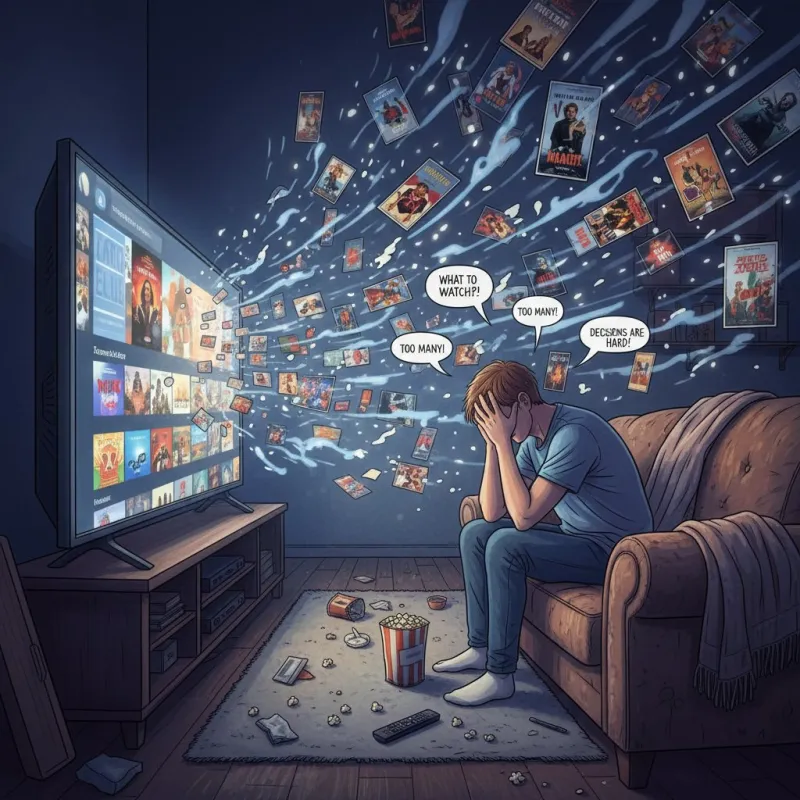
Photo: person frustrated scrolling streaming service on TV remote at night, via obrazki.ai
There's a specific kind of frustration that only exists in 2024. You sit down after a long day, crack open your streaming app of choice, and spend the next 40 minutes scrolling through thumbnails before giving up and turning on something you've already seen. You had access to more content than any human being in history — and you watched Seinfeld again.
This is the paradox nobody at Netflix, Max, or Peacock seems to want to talk about out loud: the more content these platforms pile on, the harder it gets to actually find something worth watching. And the recommendation engines they've built to solve that problem? They might be making it worse.
The Promise That Didn't Quite Deliver
When Netflix first rolled out its recommendation algorithm back in the early 2010s, it felt genuinely revolutionary. The idea was simple and seductive — the more you watched, the smarter the system got, and eventually it would know your taste better than you knew yourself. The company even famously held the Netflix Prize, a $1 million competition to improve their recommendation model. This was serious engineering applied to a very human problem.
Fast forward to today, and the experience feels less like a knowledgeable friend pointing you toward a hidden gem and more like being handed a menu that only shows you variations of things you already ordered. Watched one true crime documentary? Congratulations, your entire homepage is now a crime scene.
UX designers who've worked inside the streaming industry describe this as the "engagement trap." The algorithm isn't actually built to help you discover something new — it's built to keep you on the platform. Those are two very different goals, and they don't always point in the same direction.
"There's a fundamental tension between what users say they want and what the data shows they'll actually click on," explained one UX consultant who's worked with multiple major streaming platforms (and asked to remain anonymous because, well, NDAs). "People say they want to be challenged, introduced to new things. But when you A/B test it, familiar content wins almost every time. So the algorithm learns to serve familiar. It's just doing its job."
The Bubble You Didn't Know You Were In
Entertainment analysts have started borrowing a term from the social media world to describe what's happening: the content bubble. Just like your Facebook feed eventually shows you only things that confirm what you already believe, your streaming homepage eventually reflects only what you've already proven you like.
The problem is compounded by the fact that most major platforms now operate on a model where they're simultaneously the content creator and the curator. Netflix wants you to watch Netflix Originals. Disney+ wants you in the Marvel pipeline. When the entity recommending content is also the entity that profits from which content you choose, objectivity becomes a bit of a stretch.
Streaming analyst Deana Whitfield, who tracks platform behavior for a media research firm in New York, put it bluntly in a recent conversation: "The recommendation engine is also a marketing engine. You have to understand that. When Netflix puts something in your 'Top Picks,' that's not purely based on your watch history — that's also based on what they need you to watch."
Licensed content from third-party studios gets quietly deprioritized. Older titles that cost the platform nothing to host barely surface. Meanwhile, whatever dropped last Friday gets prime real estate.
What Human Curation Actually Did Right
Here's the thing that streaming platforms don't love admitting: the old ways of finding content were pretty good. Not perfect, obviously — nobody misses Blockbuster's late fees — but effective in ways algorithms haven't replicated.
Think about what a great video store employee actually did. They asked you what you were in the mood for. They considered context — who you were watching with, whether you wanted something light or heavy, whether you'd seen the director's other work. They made unexpected connections. They'd hand you a weird Italian horror film from 1977 because you mentioned you liked suspense and weren't afraid of something a little strange.
That kind of lateral, contextual, human recommendation is almost impossible to replicate in a system that's optimizing for clicks. Algorithms are brilliant at pattern recognition. They're not so great at intuition.
Some platforms have tried to thread this needle. The Criterion Channel has built a loyal following partly because its editorial team actively curates themed collections — films connected by director, era, theme, or cultural moment. It feels like someone actually thought about what goes together and why. Mubi operates similarly, offering a rotating selection of hand-picked films. Neither of these services has the catalog size of Netflix, but their users consistently report higher satisfaction with discovery.
"Curation is an art form," says Marcus Teel, an entertainment strategist based in Los Angeles. "When you reduce it entirely to machine learning, you lose the serendipity. You lose the 'I never would have found this on my own' moment. And that moment is actually why people love film and television in the first place."
So What Would Actually Fix This?
Some solutions are already being quietly tested. A handful of platforms have started experimenting with "mood-based" browsing — letting users set parameters like energy level, emotional tone, or even time commitment before surfacing recommendations. It's a small shift, but it acknowledges that what you want on a Tuesday night after a rough day is different from what you want on a lazy Sunday afternoon.
Others are looking at social integration — not in the creepy "share everything automatically" way that killed that feature the first time, but in a more opt-in, curated sense. Letterboxd, the film logging app, has demonstrated that people genuinely want to know what their friends are watching and loving. That social signal is something no algorithm can manufacture.
There's also growing conversation in the industry about transparency — letting users actually understand why something is being recommended to them, and giving them more direct control over their own taste profiles. Right now, most platforms treat their recommendation logic like a trade secret. Which, to be fair, it is. But users are starting to notice they're not in the driver's seat.
The Scroll Isn't Going Anywhere
None of this means streaming is going away, or that the recommendation engine is entirely useless. For mainstream content — the stuff that genuinely appeals to broad audiences — it works reasonably well. If you liked Stranger Things, it probably knows to show you Dark. Fine.
But for the weird stuff, the overlooked stuff, the film that's going to genuinely change the way you think about cinema — the algorithm is going to need some help. And until platforms start treating discovery as a genuine feature rather than a solved problem, a lot of us are going to keep ending up right back where we started.
Which, apparently, is episode three of The Office. Again.